Cord layer
Conductor metal, gauge, core count, length, jacket rating, shielding if any, bend radius, and the test the buyer wants on the lot. Those are the Cables and Wiring fields for this family.
QUALIFIED BUYER SUPPORT
Compare factory quotations on the same power-cord configuration.
Eligible first orders may receive up to 3%.
Eligibility applies to qualified business buyers and is confirmed after we review your product, quantity, destination, and sourcing requirements.
Independent sourcing partner
LinkScope Sourcing 29 collects a power cord factory request from US buyers and asks factories to price the same gauge, jacket, connectors, quantity, and destination. The desk does not hold cord inventory and it does not sign a listing file.
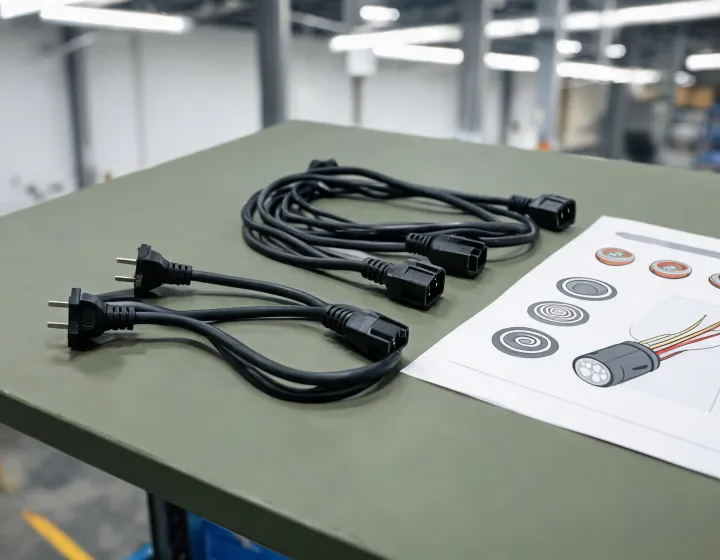
Each row is a question for the proposed cord set. A family photograph does not answer it. TIA cabling documents can frame a copper-cable conversation, but they do not rate a flexible power cord.
| Row | Buyer writes | Factory should attach |
|---|---|---|
| Metal | Stranded copper, or copper-clad aluminum if that substitution is acceptable | Conductor statement on the construction sheet for the quoted item |
| Gauge and length | 12 AWG or another size, plus feet between fittings | Finished length tolerance and the resistance method used |
| Jacket | SJTW, SOOW, STW, or the letters printed on the sample | Temperature, voltage, and outdoor or oil marks the jacket print shows |
| Ends | NEMA 5-15, locking L5-15, or IEC 60320 C13 and C14 | Blade drawing and whether the plug is molded or field-fit |
| Proof | Whether a UL 817 style cord-set file is required for this buy | File number and the exact configuration the file covers, if the factory offers one |
A buyer-side voltage-drop check can sit beside those rows. One published copper figure used for rough work is about 1.6 ohms per 1,000 feet for a 12 AWG conductor. A 100-foot cord has two current-carrying conductors, so the loop is about 0.32 ohm. At 12 A that is about 3.8 V, close to 3 percent of 125 V. Ask the factory for the resistance of the quoted construction. This arithmetic is a desk check, not a listing.
Read the procurement brief before you open the inquiry names.
Network layers do not size this product. Keep fiber, switching, and RF fields off the cord line unless they are a second purchase.
Conductor metal, gauge, core count, length, jacket rating, shielding if any, bend radius, and the test the buyer wants on the lot. Those are the Cables and Wiring fields for this family.
Power rating in volts and amperes, blade pattern, and connector mating cycle if the cord is plugged every shift. Ingress protection belongs on a weather cover or inlet, and it counts when the factory states a test for that housing.
Switching capacity, forwarding rate, wavelength, optical budget, insertion loss, return loss, VSWR, impedance, MIMO, and channel width describe other telecom products. A quote that substitutes those words for AWG should be sent back.
Quantity in pieces, the US destination, and the week the cords are needed. A target budget can name a currency and a per-piece or whole-order basis. It is not a live factory price.
Ask for the cord price, reel or carton charge, freight, duties, and any cut charge on separate lines. Incoterms should be named. Headline unit price is not the delivered total.
A catalog lead time copied from a different jacket, a scrap-copper quote, or a statement that a listing covers every length. Timing is confirmed after the configuration is fixed.
The buyer or the site inspector. LinkScope Sourcing 29 can list the checks. It does not sign the receiving report.
High-end, mid-range, budget, or undecided is your preference. It is not a rank this desk has verified.